
World Bank on Monday said it expects Indian economy to grow by 8 per cent this fiscal but asked the government to open up more sectors for foreign direct investment, encourage private sector participation and improve infrastructure.

'India is the only country whose economy is strong and growing fast.'

'The players can criticise my cricket ball. Can I criticise them for the bad shot or the bad ball? Long hop. You know what I mean? You've got to be sensible.'
This kind of growth will turn India into a $8 trillion economy.
State-owned Engineers India and MECON as well as four private entities are in the fray for the project to comprehensively revamp RBI's currency management infrastructure in order to cater to future cash needs of the country's fast growing economy. The four private entities are: Accenture Solutions; Colliers International (India) Property Services; PricewaterhouseCoopers and The Boston Consulting Group (India).

'Trump is likely being purposefully vague, hoping that this lack of clarity will pressure India, fearing the worst, to agree to scale back its imports of Russian oil.'

The resilience of the economy and strength of domestic demand will continue to make India an engine of growth amid the rapidly evolving global trade landscape as a result of US tariffs, Finance Minister Nirmala Sitharaman said in London on Tuesday.

Prime Minister Narendra Modi on Tuesday said India will become the growth engine for the world in the coming years, and the ease of doing business has improved with "mission-mode" reforms being undertaken by his government. Speaking at the BRICS Business Forum Leaders' Dialogue in Johannesburg, Modi also said India soon will become a $5 trillion economy.

Foreign investors withdrew Rs 10,355 crore from the country's equity markets in the last four trading sessions this month due to sweeping tariffs imposed by the US on most nations, including India. The outflow occurred after a net investment of Rs 30,927 crore in the six trading sessions from March 21 to March 28. This infusion helped reduce the overall outflow for March to Rs 3,973 crore, according to data from the depositories.

Technically, the Indian economy is on road to recovery.

'My job is to provide people with a bouquet of options they can choose from.'

30% of Indian employees report experiencing daily stress in their workplace. This high stress level is compounded by anger, with 34% of Indian employees experiencing daily anger at work -- a figure significantly higher than many other countries.

Australia, Canada, US and UK are restricting immigration, but other countries are opening their doors.
Buoyed by 8.4 per cent growth in the second quarter, Finance Minister Jaswant Singh said on Friday that growth of India's gross domestic product would be even better in the subsequent quarters

Planning Commission Deputy Chairman Montek Singh Ahluwalia on Monday expressed confidence that in the years to come India could emerge as the fastest growing economy in the world, beating China as the nation has yet to achieve its full growth potential.

'As the global economy undergoes significant transformations in 2025, India's ability to navigate the complexities of trade wars, financial realignments, and emerging blocs will be pivotal,' explain Harsh V Pant and Soumya Bhowmik.
'He will be remembered more for what he did as finance minister -- as someone who functioned well when the political fallout was taken care of.'

Indian economy is expected to improve marginally in the current financial year with its GDP at market price projected to expand by 3.4 per cent from 3.3 per cent in the previous fiscal, think tank OECD said.

Trade tensions between India and the US have been rising with President Donald Trump complaining that tariffs imposed by New Delhi on American products were "no longer acceptable".
Boosted by the strength of India and China, developing nations would grow 1.2 per cent this year, but without the two, these economies would shrink 1.6 per cent, says the World Bank. Warning that the world is entering an era of "slower growth", the multilateral
However, if the rupee depreciates much, the economy in dollar terms would be that much smaller.
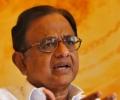
Chidambaram also hit out at senior BJP leader Yashwant Sinha, saying his performance as finance minister.
The Indian economy may grow at 7.2 per cent this fiscal on the back of improvement in consumer sentiment, policy reforms and projected growth in agriculture and industrial sector, a Assocham survey said.

Five years after the catastrophic collapse of the Wall Street, the American economy is growing and the businesses are creating jobs, Obama said yesterday while nominating Timothy Massad to run the Commodity Futures Trading Commission.
Even as services helped the Indian economy clock better than expected growth in the first half, many economists say that the sector would slow down much more in the second half and restrict growth to seven per cent or less for the whole fiscal.

The government's indirect tax collection is expected to increase by 8.3 pc in the financial year 2025-26 (FY26), according to a report by ICICI Bank. The report also noted that this growth is higher than the 7.1 per cent increase seen in FY25 and is mainly driven by rise in GST revenue from strong urban consumption. It said "The increase is driven by higher goods and services tax collections which in-turn is explained by boost to urban consumption".

The economy is likely to grow at about 5.6 per cent in 2014-15 and fiscal and current account deficits no longer pose a threat to macroeconomic stability, India Ratings said on Friday.

The government on Monday forecast annual economic growth to accelerate to 7.4 per cent in the fiscal year ending in March 2015

From the Sensex firms, Tata Steel, Power Grid, NTPC, Kotak Mahindra Bank, Reliance Industries and Adani Ports were among the biggest gainers. Asian Paints and Tata Consultancy Services were the only laggards.
While celebrated coaches like Marcelo Lippi, Jean Tigana, Segio Batista and Henk ten Cate are making their presence, so are a few big ticket players. Rediff.com takes a look at a few stars who have preferred to move eastwards from their respective European clubs.

Growth in corporate profits needs to be commensurate with wages to boost the economy, Economic Survey 2024-25 said, noting that sharp disparities between the two pose risk to the economy by curbing demand. The document tabled in Parliament on Friday noted that while the labour share of GVA (gross value added) shows a slight uptick, the disproportionate rise in corporate profitsredominantly among large firmsaises concerns about income inequality.

Gold prices rose by Rs 70 to hit yet another record high of Rs 98,170 per 10 grams in the national capital on Thursday amid firm global demand, according to the All India Sarafa Association. On Wednesday, the precious metal of 99.9 per cent purity soared by Rs 1,650 to hit an all-time high of Rs 98,100 per 10 grams.

Whether you're a young professional, a seasoned entrepreneur, or someone simply looking to take control of your financial future, adopting these principles can be life-changing, says Ramalingam Kalirajan

The time is ideal for a 'Dream Budget' akin to the 1991 reforms that sparked high growth and unlocked significant gains in productivity, points out Rajeswari Sengupta.
C Rangarajan, chairman of the Prime Minister's Economic Advisory Council, on Thursday said he expects the Indian economy to grow by 8.5 per cent in FY'12 on the back of services sector and industry expansion, though he hinted that agriculture might not be a big contributor.
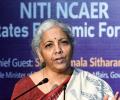
'Each state is unique, but when it comes to finance, the fundamentals cannot be different.'

The current situation in Kerala politics is perhaps best described as a case of the state's traditional two front politics now seeing a third front (the BJP) muscling in with the potential outcome being either a messy three front affair or a renewed endorsement of the two front pattern but with one of the old fronts compromised or quashed, observes Shyam G Menon.

'I think today RBI supervision is much sharper than what it was earlier.'

Australia on Wednesday unveiled an ambitious roadmap to deepen and diversify its trade and investment ties with India. The roadmap identified four "superhighways of growth" -- clean energy, education and skills, agribusiness, and tourism. Broadly, it sets out a pathway to focus ongoing efforts, including to boost two-way investment, and work with Indian-Australian communities and businesses.

'Will this near-war, India's strongest military response so far, buy India another seven years of deterrence?' asks Shekhar Gupta.
